Monday, August 27, 2012

The speech that Nixon never gave: ‘In event of moon disaster’

Neil Armstrong, who died on Saturday, is being remembered as the astronaut who took the the first step on the moon.
But the successful lunar landing on July 20, 1969, was not a given. A memo of a speech drafted by William Safire just days before the landing, is surfacing again on the Web. The memo is titled "In Event of Moon Disaster."
Back in 1999, William Safire discussed the undelivered speech with Tim Russert on NBC's "Meet The Press."
Safire was asked to consider an alternative to a successful moon landing.
Nixon's speech writer explained, "At that time, the most dangerous part of the moon mission, was getting the moon module back up into orbit and join the command ship."
Safire added, "But if they couldn't , they would have to be abandoned on the moon, left to die there. And mission control would have to close down communication. The men would either starve to death or commit suicide."
The moving text of the speech, sent to President Nixon's chief of staff, H.R. Halderman, was thankfully never used. It begins, "Fate has ordained that the men who went to the moon to explore in peace will stay on the moon to rest in peace.
These brave men, Neil Armstrong and Edwin Aldrin, know that there is no hope for their recovery. But they also know that there is hope for mankind in their sacrifice."
The speech continues,
They will be mourned by their families and friends; they will be mourned by their nation; they will be mourned by the people of the world; they will be mourned by a Mother Earth that dared send two of her sons into the unknown.
In their exploration, they stirred the people of the world to feel as one; in their sacrifice, they bind more tightly the brotherhood of man.
In ancient days, men looked at stars and saw their heroes in the constellations. In modern times, we do much the same, but our heroes are epic men of flesh and blood.
Others will follow, and surely find their way home. Man's search will not be denied. But these men were the first, and they will remain the foremost in our hearts.
For every human being who looks up at the moon in the nights to come will know that there is some corner of another world that is forever mankind.
Retweet this story

Sunday, August 26, 2012

Senators banned Facebook Co-Founder Saverin from America: Don't come back. Ever.


Retweet this story

Senators ban Saverin from America: Don't come back. Ever.


Eduardo Saverin's decision to leave the United States with his money, but not his citizenship, has apparently touched a nerve in the Senate.
Sens. Chuck Schumer and Bob Casey held a press conference Thursday morning on Capitol Hill where they outlined legislation that would prevent the Facebook co-founder from ever returning to the United States.
Saverin, who now lives in Singapore, renounced his U.S. citizenship earlier this year. He will become astronomically wealthy on Friday when his former venture is listed on the NASDAQ. By renouncing his citizenship, Saverin is likely to avoid capital gains taxes on his Facebook shares.
Schumer called Saverin's decision "outrageous" and labeled his tactics a "scheme."
"Saverin has turned his back on the country that welcomed him and kept him safe, educated him, and helped him become a billionaire," Schumer said. "This is a great American success story gone horribly wrong."
Saverin and his representatives insist the Brazilian native did not renounce his citizenship for tax reasons.
In statement to CNN on Thursday, Saverin said it was "unfortunate" that his choice had led to a debate "based not on the facts, but entirely on speculation and misinformation."
"I am obligated to and will pay hundreds of millions of dollars in taxes to the United States government," Saverin said. "I have paid and will continue to pay any taxes due on everything I earned while a U.S. citizen."
Still, it seems likely that the move will help Saverin escape some of the hefty taxes he'd have to pay on his Facebook stake, though it's not known exactly how much of the company Saverin currently owns.
He owned 5% of the company's outstanding shares as recently as 2009, according to "The Facebook Effect," by David Kirkpatrick, but he has sold off some of those shares since then. He was not listed among those owning 5% or more of the company in Facebook's pre-IPO regulatory filings.
The Brazilian-born Facebook co-founder became a U.S. citizen in 1998 and has been living in Singapore since 2009, but the United States requires its citizens to pay income taxes no matter where they live. Saverin, who provided some of Facebook's initial financing, has not played an active role in the company for many years.
Schumer and Casey are calling their bill the "Ex-PATRIOT Act."
The proposal says that if a wealthy American seeks to renounce their citizenship, it will be presumed they have done so for tax purposes, unless the individual can convince the IRS otherwise.
If the person is unable to convince the IRS, they will be subject to 30% capital gains tax on future U.S. investments no matter where they live. Furthermore, they will not be allowed back into the United States. "Period," Schumer said. "They could not set foot in this country again." Retweet this story

Saturday, August 25, 2012

1st man to walk on the moon, dies at 82: Armstrong

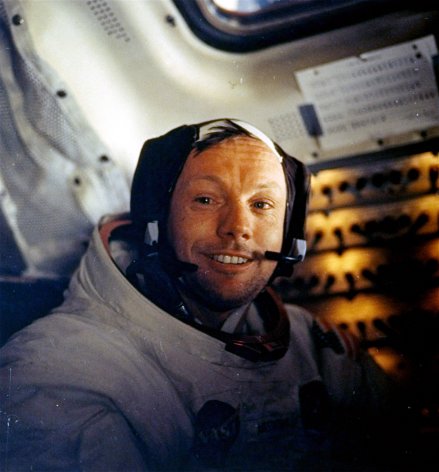
This July 20, 1969 file photo provided by NASA shows Neil Armstrong. The family of Neil Armstrong, the first man to walk on the moon, says he has died at age 82. A statement from the family says he died following complications resulting from cardiovascular procedures. It doesn't say where he died. Armstrong commanded the Apollo 11 spacecraft that landed on the moon July 20, 1969. He radioed back to Earth the historic news of "one giant leap for mankind." Armstrong and fellow astronaut Edwin "Buzz" Aldrin spent nearly three hours walking on the moon, collecting samples, conducting experiments and taking photographs. In all, 12 Americans walked on the moon from 1969 to 1972. (AP Photo/NASA)
Neil Armstrong was a soft-spoken engineer who became a global hero when as a steely-nerved pilot he made "one giant leap for mankind" with a small step onto the moon. The modest man, who had people on Earth entranced and awed from almost a quarter-million miles away, but credited others for the feat, died Saturday. He was 82.
Armstrong died following complications resulting from cardiovascular procedures, his family said in a statement. It didn't say where he died; he had lived in suburban Cincinnati.
Armstrong commanded the Apollo 11 spacecraft that landed on the moon July 20, 1969, capping the most daring of the 20th century's scientific expeditions. His first words after becoming the first person to set foot on the surface are etched in history books and the memories of those who heard them in a live broadcast.
"That's one small step for man, one giant leap for mankind," Armstrong said.
(Armstrong insisted later that he had said "a'' before man, but said he too couldn't hear it in the version that went to the world.)
In those first few moments on the moon, during the climax of a heated space race with the then-Soviet Union, Armstrong stopped in what he called "a tender moment" and left a patch to commemorate NASA astronauts and Soviet cosmonauts who had died in action.
"It was special and memorable but it was only instantaneous because there was work to do," Armstrong told an Australian television interviewer this year.
Armstrong and Buzz Aldrin spent nearly three hours walking on the lunar surface, collecting samples, conducting experiments and taking photographs.
"The sights were simply magnificent, beyond any visual experience that I had ever been exposed to," Armstrong once said.
The moonwalk marked America's victory in the Cold War space race that began Oct. 4, 1957, with the launch of the Soviet Union's Sputnik 1, a 184-pound satellite that sent shock waves around the world.
Although he had been a Navy fighter pilot, a test pilot for NASA's forerunner and an astronaut, Armstrong never allowed himself to be caught up in the celebrity and glamour of the space program.
"I am, and ever will be, a white socks, pocket protector, nerdy engineer," he said in February 2000 in one of his rare public appearances. "And I take a substantial amount of pride in the accomplishments of my profession."
A man who kept away from cameras, Armstrong went public in 2010 with his concerns about President Barack Obama's space policy that shifted attention away from a return to the moon and emphasized private companies developing spaceships. He testified before Congress and in an email to The Associated Press, Armstrong said he had "substantial reservations," and along with more than two dozen Apollo-era veterans, he signed a letter calling the plan a "misguided proposal that forces NASA out of human space operations for the foreseeable future."
NASA chief Charles Bolden recalled Armstrong's grace and humility in a statement Saturday.
"As long as there are history books, Neil Armstrong will be included in them, remembered for taking humankind's first small step on a world beyond our own," Bolden said.
Armstrong's modesty and self-effacing manner never faded.
When he appeared in Dayton in 2003 to help celebrate the 100th anniversary of powered flight, he bounded onto a stage before 10,000 people packed into a baseball stadium. But he spoke for only a few seconds, did not mention the moon, and quickly ducked out of the spotlight.
He later joined former astronaut and Sen. John Glenn to lay wreaths on the graves of Wilbur and Orville Wright. Glenn introduced Armstrong and noted it was 34 years to the day that Armstrong had walked on the moon.
"Thank you, John. Thirty-four years?" Armstrong quipped, as if he hadn't given it a thought.
At another joint appearance, the two embraced and Glenn commented: "To this day, he's the one person on Earth, I'm truly, truly envious of."
Armstrong's moonwalk capped a series of accomplishments that included piloting the X-15 rocket plane and making the first space docking during the Gemini 8 mission, which included a successful emergency splashdown.
In the years afterward, Armstrong retreated to the quiet of the classroom and his southwest Ohio farm. Aldrin said in his book "Men from Earth" that Armstrong was one of the quietest, most private men he had ever met.
In the Australian interview, Armstrong acknowledged that "now and then I miss the excitement about being in the cockpit of an airplane and doing new things."
At the time of the flight's 40th anniversary, Armstrong again was low-key, telling a gathering that the space race was "the ultimate peaceful competition: USA versus U.S.S.R. It did allow both sides to take the high road with the objectives of science and learning and exploration."
Glenn, who went through jungle training in Panama with Armstrong as part of the astronaut program, described him as "exceptionally brilliant" with technical matters but "rather retiring, doesn't like to be thrust into the limelight much."
Derek Elliott, curator of the Smithsonian Institution's U.S. Air and Space Museum from 1982 to 1992, said the moonwalk probably marked the high point of space exploration.
The manned lunar landing was a boon to the prestige of the United States, which had been locked in a space race with the former Soviet Union, and re-established U.S. pre-eminence in science and technology, Elliott said.
"The fact that we were able to see it and be a part of it means that we are in our own way witnesses to history," he said.
The 1969 landing met an audacious deadline that President Kennedy had set in May 1961, shortly after Alan Shepard became the first American in space with a 15-minute suborbital flight. (Soviet cosmonaut Yuri A. Gagarin had orbited the Earth and beaten the U.S. into space the previous month.)
"I believe this nation should commit itself to achieving the goal, before the decade is out, of landing a man on the moon and returning him safely to Earth," Kennedy had said. "No single space project in this period will be more impressive to mankind, or more important to the long-range exploration of space; and none will be so difficult or expensive to accomplish."
The end-of-decade goal was met with more than five months to spare. "Houston: Tranquility Base here," Armstrong radioed after the spacecraft settled onto the moon. "The Eagle has landed."
"Roger, Tranquility," Apollo astronaut Charles Duke radioed back from Mission Control. "We copy you on the ground. You've got a bunch of guys about to turn blue. We're breathing again. Thanks a lot."
The third astronaut on the mission, Michael Collins, circled the moon in the mother ship Columbia 60 miles overhead while Armstrong and Aldrin went to the moon's surface.
Collins told NASA on Saturday that he will miss Armstrong terribly, spokesman Bob Jacobs tweeted.
In all, 12 American astronauts walked on the moon between 1969 and the last moon mission in 1972.
For Americans, reaching the moon provided uplift and respite from the Vietnam War, from strife in the Middle East, from the startling news just a few days earlier that a young woman had drowned in a car driven off a wooden bridge on Chappaquiddick Island by Sen. Edward Kennedy. The landing occurred as organizers were gearing up for Woodstock, the legendary three-day rock festival on a farm in the Catskills of New York.
Armstrong was born Aug. 5, 1930, on a farm near Wapakoneta in western Ohio. He took his first airplane ride at age 6 and developed a fascination with aviation that prompted him to build model airplanes and conduct experiments in a homemade wind tunnel.
As a boy, he worked at a pharmacy and took flying lessons. He was licensed to fly at 16, before he got his driver's license.
Armstrong enrolled in Purdue University to study aeronautical engineering but was called to duty with the U.S. Navy in 1949 and flew 78 combat missions in Korea.
After the war, Armstrong finished his degree from Purdue and later earned a master's degree in aerospace engineering from the University of Southern California. He became a test pilot with what evolved into the National Aeronautics and Space Administration, flying more than 200 kinds of aircraft from gliders to jets.
Armstrong was accepted into NASA's second astronaut class in 1962 — the first, including Glenn, was chosen in 1959 — and commanded the Gemini 8 mission in 1966. After the first space docking, he brought the capsule back in an emergency landing in the Pacific Ocean when a wildly firing thruster kicked it out of orbit.
Armstrong was backup commander for the historic Apollo 8 mission at Christmastime in 1968. In that flight, Commander Frank Borman, and Jim Lovell and Bill Anders circled the moon 10 times, and paving the way for the lunar landing seven months later.
Aldrin said he and Armstrong were not prone to free exchanges of sentiment.
"But there was that moment on the moon, a brief moment, in which we sort of looked at each other and slapped each other on the shoulder ... and said, 'We made it. Good show,' or something like that," Aldrin said.
An estimated 600 million people — a fifth of the world's population — watched and listened to the landing, the largest audience for any single event in history.
Parents huddled with their children in front of the family television, mesmerized by what they were witnessing. Farmers abandoned their nightly milking duties, and motorists pulled off the highway and checked into motels just to see the moonwalk.
Television-less campers in California ran to their cars to catch the word on the radio. Boy Scouts at a camp in Michigan watched on a generator-powered television supplied by a parent.
Afterward, people walked out of their homes and gazed at the moon, in awe of what they had just seen. Others peeked through telescopes in hopes of spotting the astronauts.
In Wapakoneta, media and souvenir frenzy was swirling around the home of Armstrong's parents.
"You couldn't see the house for the news media," recalled John Zwez, former manager of the Neil Armstrong Air and Space Museum. "People were pulling grass out of their front yard."
Armstrong, Aldrin and Collins were given ticker tape parades in New York, Chicago and Los Angeles and later made a 22-nation world tour. A homecoming in Wapakoneta drew 50,000 people to the city of 9,000.
In 1970, Armstrong was appointed deputy associate administrator for aeronautics at NASA but left the following year to teach aerospace engineering at the University of Cincinnati.
He remained there until 1979 and during that time bought a 310-acre farm near Lebanon, where he raised cattle and corn. He stayed out of public view, accepting few requests for interviews or speeches.
"He didn't give interviews, but he wasn't a strange person or hard to talk to," said Ron Huston, a colleague at the University of Cincinnati. "He just didn't like being a novelty."
Those who knew him said he enjoyed golfing with friends, was active in the local YMCA and frequently ate lunch at the same restaurant in Lebanon.
In 2000, when he agreed to announce the top 20 engineering achievements of the 20th century as voted by the National Academy of Engineering, Armstrong said there was one disappointment relating to his moonwalk.
"I can honestly say — and it's a big surprise to me — that I have never had a dream about being on the moon," he said.
From 1982 to 1992, Armstrong was chairman of Charlottesville, Va.-based Computing Technologies for Aviation Inc., a company that supplies computer information management systems for business aircraft.
He then became chairman of AIL Systems Inc., an electronic systems company in Deer Park, N.Y.
Armstrong married Carol Knight in 1999, and the couple lived in Indian Hill, a Cincinnati suburb. He had two adult sons from a previous marriage.
It's the second death in a month of one of NASA's most visible, history-making astronauts. Sally Ride, the first American woman in space, died of pancreatic cancer on July 23 at age 61.
One of NASA's closest astronaut friends was fellow Ohioan, Mercury astronaut John Glenn, the first American to orbit the Earth.
Just prior to the 50th anniversary of Glenn's orbital flight this past February, Armstrong offered high praise to the elder astronaut and said that Glenn had told him many times how he wished he, too, had flown to the moon on Apollo 11. Glenn said it was his only regret.
Noted Armstrong in an email: "I am hoping I will be 'in his shoes' and have as much success in longevity as he has demonstrated." Glenn is 91.
At the Griffith Observatory in Los Angeles on Saturday, visitors held a minute of silence for Armstrong. His family's statement made a simple request for anyone else who wanted to remember him:
"Honor his example of service, accomplishment and modesty, and the next time you walk outside on a clear night and see the moon smiling down at you, think of Neil Armstrong and give him a wink."
Retweet this story

Thursday, August 23, 2012

Who Will Be The First To Build Next Supersonic Passage Plane?

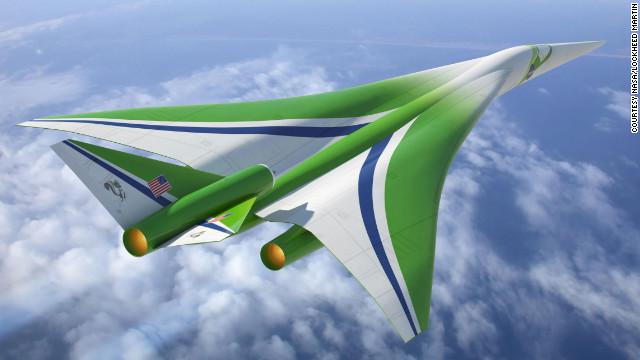
 The Lockheed Martin-led team's design for an aircraft that could fly at supersonic speed over land.
For more than three decades, Concorde represented the pinnacle of business travel -- the ultimate status symbol for the jetset executive.
Considered a marvel of aviation technology, the distinctive droop-nosed aircraft traveled at twice the speed of sound, flying from London to New York in about three and a half hours -- half the time of commercial airliners.
But even before an Air France Concorde crashed in 2000, killing all 100 passengers and nine crew members on board, the luster was beginning to wane.
Battling high operating costs and low passenger numbers, Air France and British Airways grounded their small, aging fleet a mere three years later.
But the dream of supersonic flight has not disappeared. Aviation manufacturers such as Boeing, Lockheed Martin and Aerion are working on supersonic technology -- with the latter predicting it could have a supersonic business jet in service as early as 2020.
Industry expert Joe Lissenden, the director of aerospace and defense consulting in the Americas for IHS Jane's, says it's likely that a next-generation supersonic commercial aircraft will emerge.
High demand from passengers, historic profitability on the routes and significant technological improvements have combined to make supersonic flight all the more viable, he said.

For Lissenden, the one challenge that remains is fuel cost. "Faster flights consume fuel faster which makes the flight more expensive," he said. "But this is a premium route, and premium prices will be charged."
Crucial to the efforts to restore supersonic aircraft to the skies is the work of national aerospace programs such as NASA and Japan's JAXA. Peter Coen is the supersonics research project manager for NASA's fundamental aeronautics program.
While the agency is not working on a specific supersonic aircraft, he said, "we are working on technologies we feel represent barriers to bringing back successful supersonic aircraft."
Those barriers include high atmosphere emissions, noise produced when taking off and landing, and the sonic boom -- the sound associated with the shockwaves created when objects travel faster than the speed of sound, which has prevented supersonic aircraft from flying overland routes.
Coen said his division was concentrated on addressing the sonic boom issue first, because "if you don't have overland supersonic flight, there's never going to be a market for the supersonic aircraft."
NASA has been collaborating with Boeing and Lockheed Martin on systems-level design studies, with each manufacturer producing models that have been subjected to wind tunnel testing to gauge their effectiveness.
Coen said phase one testing had successfully validated the basic design techniques. Reshaping the aircraft, the designs -- Boeing's two-jet configuration with engines mounted above the wing, and Lockheed Martin's tri-jet configuration, with two engines below the wing and a third mounted in the tail -- had been proven to significantly reduce the sonic boom to a "thump," dropping the noise from Concorde levels to close to what is considered the level of acceptability.
Coen said he expected to see a next-generation "son of Concorde" in the marketplace by around 2030, while a supersonic business jet "could happen sooner."
"The boom is the barrier and if we can get past that, I think we'll see people giving supersonic flight a lot more serious consideration," he said.
The Japan Aerospace Exploration Agency (JAXA) also hopes to develop a supersonic passenger aircraft that is quiet, economical and environmentally friendly, and expects to achieved it some time this century.
Spokesman Masahisa Honda said that while the agency currently had no aircraft in specific development, along current projections it predicted a supersonic business jet to enter the market some time after 2015.

One of the frontrunners to do so is the Aerion SBJ, an 8-12 passenger business jet. "It will herald a return to supersonic civil flight without Concorde's environmental and economic drawbacks," said Aerion spokesman Adam Konowe.
He said development of a joint venture with aircraft manufacturers to produce the SBJ had been slowed by the recession, but once a deal was struck he anticipated a six-year development program to bring the aircraft to market. "We believe the SBJ will be certified, and enter service around the end of the decade -- 2020," he said.
But not everyone is convinced that a return to supersonic passenger flight is just around the corner. Chris Seymour, head of market analysis with aviation experts Ascend, was skeptical that there would be much progress before at least 2030.
"I think there's so many issues to be considered that I certainly can't see it happening in the next 20 years," he said.
Seymour believes that although technological barriers will likely be overcome, the key factor in whether it will become a reality is whether a market exists that is prepared to pay a premium for the ultimate status symbol in business travel -- particularly in an air-travel market that is focused on low prices.
"Will you have enough passengers willing to pay higher fares to fly more quickly?" He said. "If you look at Concorde, that wasn't the case. It came along at a time when the 747 also came in, which carried more people for lower fares. That's where the market was."
Peter Warth, director of Complete Aviation Solutions, also believes that a return to supersonic flight is further off than some are making out.
"There seems to be multiple technological and commercial obstacles that will need to be cleared," he said.
But he conceded: "I'm sure that when the original plans for Concorde, the A380 and the 787 Dreamliner were announced, the same questions about whether it could be achieved were asked. But they eventually delivered. I think time will tell."
Retweet this story

Wednesday, August 22, 2012

Smartphone users exceed 30 million in S. Korea

Tech-savvy South Korea has more mobile phones than people
More than 60 percent of South Koreans now have smartphones despite their belated debut in the country, according to the latest industry figures.
Data from three mobile providers quoted by Yonhap news agency showed the number reached 30.03 million on Monday, out of a total of 52.55 million mobile phone users.
The tech-savvy nation has more mobile phones than people. The population hit 50 million in June.
South Koreans fell in love with smartphones relatively late compared to some other countries. Regulators approved Apple's iPhone only in September 2009 because of privacy concerns about some of its features.
Since then the use of smartphones has been growing at a brisk pace, with free wireless networks and cutting-edge gadgets widely available.
South Korea is one of the world's most wired societies, with 95 percent of homes using broadband Internet. It also has the world's top Internet download speeds, according to a study by Pando Networks. Retweet this story

Apple-Samsung To End Their Dispute

Apple and Samsung each laid claim to the spirit of Silicon Valley innovation as they delivered their closing arguments in their multibillion-dollar patent battle.
Apple is demanding total damages of up to $2.75bn from Samsung for what it alleges is wilful infringement of its design patents and so-called "trade dress" rights for the iPhone and iPad in the US.
Samsung, which countersued over Apple's alleged use of its wireless transmission patents and other underlying mobile-phone technology, is looking for $422m from its rival in compensation.
Two additional courtrooms were provided to accommodate the large number of reporters and observers who came to the San Jose courthouse for Tuesday's closing arguments, the biggest crowd yet seen in the case.
Addressing the nine jurors, Harold McElhinny of Morrison Foerster, Apple's lead counsel, compared a romantic portrayal of Apple's design process to what he characterised as Samsung's rapid "knock-off" of the iPhone.
"Everyone, even Samsung, thought that the iPhone changed the world," Mr McElhinny said. "Samsung was the iPhone's biggest fan ... They tried to compete with it and when they couldn't, they copied it."
In turn, outlining its closing argument, Samsung sought to portray Apple as a would-be monopolist that wanted to extract punitive damages for what its counsel suggested was a natural evolution of technology.
Mr McElhinny suggested that "every smartphone does not have to look like an iPhone", showing pictures of other devices including Nokia's Lumia and a Casio phone.
Mr McElhinny alleged that Samsung had "disrespected" the legal process by refusing to bring its most senior executives over from South Korea, a position he contrasted with appearances from Apple's Scott Forstall and Phil Schiller, its software and marketing chiefs respectively. "They were willing to face cross examination," he said. "No Samsung executive was prepared to come here from Korea and answer questions under oath. Instead of witnesses, they sent you lawyers."
Mr McElhinny's summing up focused on Samsung internal documents that referenced the Korean firm's "crisis of design" in the face of the iPhone. He pointed to warnings from Google that Samsung should not copy Apple's device too closely, which he alleged Samsung ignored in a three-month design process.
"In those critical three months, Samsung was able to copy and incorporate the results of Apple's four-year investment in hard work and ingenuity without taking any of the risks, because they were copying the world's most successful product," he said.
The subsequent boost to Samsung's smartphone sales prompted "a whole series of iPhone knock-offs," Mr McElhinny alleged.
"If you render judgment for Apple in this case, you will have reaffirmed the American patent system," Mr McElhinny concluded. "People in this valley will continue to invest -- they will hire people -- because they know those investments will be protected."
For Samsung, referencing the huge press attention on the case, Charles Verhoeven, a partner at Quinn Emanuel Urquhart & Sullivan, told the jury: "Your decision ... could change the way competition works in this country ... Is this country going to have vigorous competition between competitors? Or giant competitors armed with patent arsenals that block competition?"
Despite representing a Korean firm against a local Californian company, Mr Verhoeven played on the innovation that the area around San Jose is famous for.
"Competition is what has changed this country. We can see it ourselves in Silicon Valley," he said. "The real reason Apple's bringing this case is that rather than competing in the marketplace, Apple is seeking a competitive edge through the courtroom ... Apple says it's entitled to have a monopoly on a rectangle with rounded corners on a large screen."
Mr Verhoeven also pointed to what he said were examples of "prior art" that invalidated Apple's design patents.
The closing arguments came after a four-week hearing that has tested the technical understanding of the nine-person jury and the patience of Judge Lucy Koh, who has frequently clashed with Apple and Samsung's counsel as they squabbled daily over the evidence, procedure and presentation of the case.
Last Thursday, Judge Koh, herself a former patent attorney, said that Apple's lawyer must be "smoking crack" if he expected to call a large number of witnesses in the two hours of court time remaining. Last-ditch attempts by the judge to encourage a settlement between the two companies did not succeed despite Samsung and Apple chief executives again discussing the case in recent days.
But Judge Koh has also tried to be sympathetic to the jury as it grapples with a complex set of legal and technological issues.
"I need everybody to stay conscious ... including me," she said before beginning to read out 84 instructions to the jury for how they should decide the case and calculate any award of damages. People in the courtroom were encouraged to stand up occasionally "to make sure the blood's still flowing".
Jurors must wade through a 20-page verdict form designed to guide them through their decision, which must be unanimous. A verdict could take several days.
Retweet this story