Thursday, October 11, 2012

Lenovo surpass HP as world's top PC maker

Chinese PC maker Lenovo has replaced Hewlett-Packard as the world's top PC maker, according to preliminary figures released by research firm Gartner.
Gartner said Lenovo shipped 13.8 million units in the third quarter, compared with HP's 13.55 million.
It said Lenovo's "aggressive" price cuts had helped it gain substantial market share.
However, research firm IDC's data put HP at the top, though it showed the gap between the two was closing.
According to IDC, HP shipped 13.9 million units, giving it a 15.9% share of the global market, compared with Lenovo which enjoyed a 15.7% share with 13.8 million units.
Analysts said that Lenovo has been among the best performing PC makers in recent times and was likely to gain further market share.
"Just the momentum that Lenovo has had, makes it inevitable that it will be the world's number one PC maker across all charts," Andrew Milroy of Frost & Sullivan told the BBC.
According to Gartner, Lenovo was the only PC maker, among the world's top five, that increased its shipments to the US during the third quarter.

Global Q3 PC shipments - Gartner

Manufacturer Units (millions) Market share
Lenovo 13.77 15.7%
HP 13.55 15.5%
Dell 9.22 10.5%
Acer 8.63 9.9%
ASUS 6.38 7.3%
Others 35.95 41.1%
Total 87.50 100%
'Severe slump' Both Gartner and IDC's figures showed that global PC shipments fell more than 8% during the quarter, from the same period last year.
Demand for personal computers has been hurt by a slowing global economy as well as the growing popularity of tablet PCs such as Apple's iPad and Samsung's Galaxy range.
Analysts said that consumers held back on purchases during the period in anticipation of the launch of new products as well as operating systems, including Microsoft Windows 8.
"PCs are going through a severe slump," said Jay Chou, senior research analyst at IDC's Worldwide PC Tracker.
"The industry had already weathered a rough second quarter, and now the third quarter was even worse."
He added that the industry was also struggling to find a product that may help it turn around its fortunes.
"The hard question of what is the 'it' product for PCs remains unanswered. While ultrabook prices have come down a little, there are still some significant challenges that will greet Windows 8 in the coming quarter."

Global Q3 PC shipments - IDC

Manufacturer Units (millions) Market share
HP 13.95 15.9%
Lenovo 13.82 15.7%
Dell 9.50 10.8%
Acer 8.41 9.6%
ASUS 6.38 7.3%
Others 35.73 40.7%
Total 87,80 100%


please leave your comment below 
Retweet this story

Wednesday, October 10, 2012

Spotify to stream music on Samsung TVs in Europe

A South Korean man walks past a Samsung Smart TV advertisement
Swedish music streaming service Spotify said Wednesday the South Korean electronics giant Samsung would be first to offer its music catalogue on its Smart TVs in Europe.
Spotify said it would offer customers an application they could download for Samsung's Smart TVs in 12 European countries, including Britain, Denmark, France, Germany, Spain and Sweden.
Spotify's three non-European markets -- the US, Australia and New Zealand -- would not have access to the service.
"People no longer need to fuss about connecting cables from their laptop or tablet to Hi-Fi equipment," said Dan Saunders, director of content services for Samsung Electronics Europe.
Founded in 2006 by Swedes Daniel Ek, then in his twenties, and Martin Lorentzon, the service first launched in 2008 in Sweden and says it has since become the world's largest streaming service.
It claims to have a catalogue of "more than 18 million songs", "more than 15 million active users and more than four million paying customers."

are you a music fan, please leave your comment below Retweet this story

Bluetooth Speaker That Works While On Water

 
Speakers and water typically don’t mix. Bring them near a swimming pool, in a boat or by the lake and you’ll likely regret it. for more click here
Retweet this story

Monday, October 8, 2012

India will launch 58 space missions in next 5 years


India is planning to launch 58 space missions, including sending spacecraft to Moon and Mars, an exclusive satellite to keep a round-the-clock watch on the country and deploy hundreds of transponders in the next five years, reported Press Trust of India on Sunday.
The India Space Research Organization also aims to deploy its own version of the Global Positioning System by putting into orbit a constellation of seven satellites which would form the Indian Regional Navigational Satellite System, during its 12th Five Year Plan, approved by the government last week, said the report.
An indicative plan outlay of 397 billion rupees (about 7 billion U.S. dollars) for the 12th Plan has been made for the department of space.
"Overall, 58 missions are planned for realization during 12th Plan period which includes 33 satellite missions and 25 launch vehicle missions," the 12th Plan document was quoted as saying.
The space agency is also designing a special Geo-Imaging Satellite to be stationed 36,000 km above to maintain round-the- clock vigil and assist state authorities to tackle natural disasters, floods and forest fires and keep a watch over the country's sensitive borders, according to the report. Retweet this story

Saturday, October 6, 2012

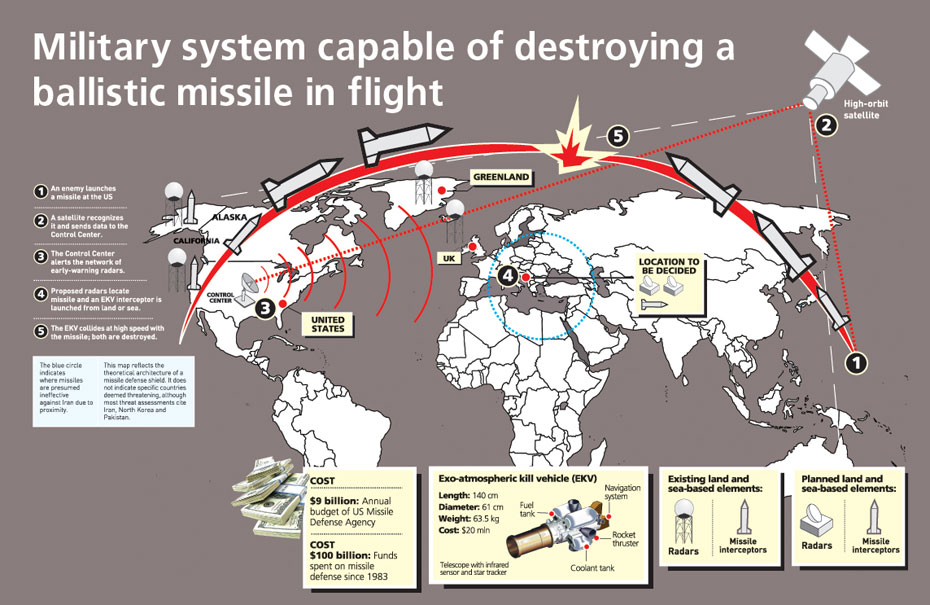
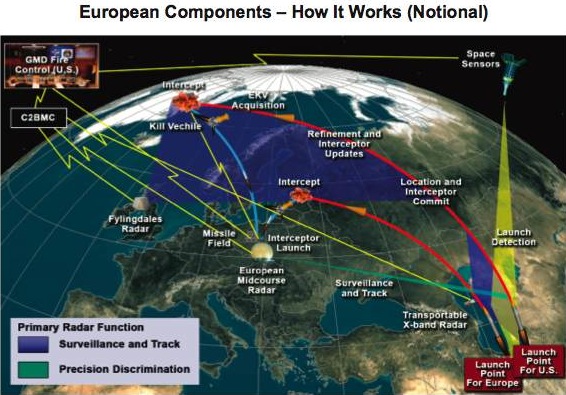
US,NATO missile shield in Spain


The Spanish government has agreed to participate in NATO's anti-missile shield that will see specialized United States warships based at a Spanish base already used by the U.S. Navy.
Deputy Prime Minister Soraya Saenz de Santamaria said Spain and the U.S. had sealed the deal Friday to use the base in southwestern Spain as part of the shield, enabling four U.S. Navy destroyers and some 1,400 operators to be deployed at the base.
Moscow has long opposed the shield and called for binding guarantees from the U.S. and NATO that it will not target Russia.
The Pentagon also has units at Moron air base in southwest Spain, with a presence of some 4,250 military personnel and 1,000 civilians in the country.
Retweet this story

Military Flying Drones Can now Refuel Themselves at Mid-Air

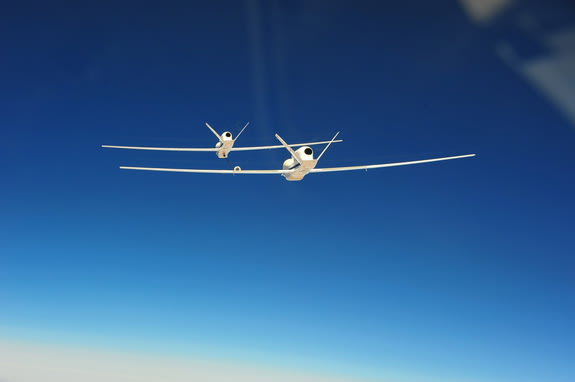
U.S. military flight tests have shown how drones could handle midair refueling by themselves, without human pilots. That raises the possibility of automated "flying gas stations" topping off robotic aircraft over future battlefields.
The U.S. Defense Advanced Research Projects Agency (DARPA) recently flew two modified RQ-4 Global Hawk drones in close proximity to simulate midair refueling. The Global Hawks, huge drones with 131-foot wingspans used for high-altitude surveillance, flew in formation with less than 100 feet separating the refueling "probe" on one and refueling "receiver" on the other during a two-and-a-half hour flight test.
"The goal of this demonstration was to create the expectation that future [High Altitude Long Endurance] aircraft will be refueled in flight," said Jim McCormick, program manager at DARPA.

Neither Global Hawk drone needed human guidance during the final flight test at the high altitude of 44,800 feet (8 miles). The drones also maintained their tight formation despite turns and wind gusts of up to 23 mph.
DARPA had kicked off its two-year Autonomous High-Altitude Refueling (AHR) program with the expectation that just one out of six aerial refueling attempts would prove successful. But the final analysis suggested drones could achieve a much better success rate of three out of five attempts.
The results from the AHR program that ended on Sept. 30 mean the U.S. military has a good chance of extending the duration and range of its drone swarms. Manned fighter jets and bombers already do midair refueling from standard tanker aircraft, but many drones can't match the speed, altitude or performance of existing tanker aircraft.
McCormick suggested that the drone flight-testing could lead to "non-traditional tanker concepts," perhaps a reference to automated drone tankers. Such an idea could work very well for the range of midsize or large drones that depend on jet fuel.
The U.S. military has also played with other refueling ideas for drones. Lasers could do midair recharging for smaller, battery-powered drones, such as the Stalker drone flown by U.S. Special Forces. Meanwhile, the U.S. Navy has plans for its aircraft-size X-47B drone, — designed to take off and land on Navy aircraft carriers — to autonomously handle aerial refueling with standard tanker aircraft.
Retweet this story

Friday, October 5, 2012

Galaxy Photo Camera For Browsing


Samsung’s Galaxy Camera not only runs Android like a smartphone, it will also have a data plan much like your favorite handset.
It was announced earlier this year, but AT&T said Thursday that it will be bringing the smart camera to its network “in the coming weeks.”
For more story click here Retweet this story